Friday, 13 January 2023

This Blogger's view on tallness

Strength to weight ratio is said to be the number one important thing in climbing.

A big problem... maybe you've heard... all competition climbers have eating disorders. Or maybe it's that they will have in 5 years. Or maybe it's that skeletons have risen from the dead and are eating all the world cup medals. We need a system in place to discourage eating disorders, particularly for young people.

One suggestion is for climbers to have a minimum BMI in order to compete. This is supposedly fraught with legal issues. But maybe it would work similarly to boxing, with different weight categories? 

Regardless:

BMI is the ratio of height to weight... So let's imagine a young person (using he/him pronouns) is looking to make it to the top by any means. He needs to have the acceptable BMI but also wants to be as light as possible. He therefore reasons he needs to be as short as possible. The best way to be as short as possible is under eating during childhood, so he potentially got eating disorders even earlier. The BMI rule may actually create more problems, looked at in this way.

 Here is an alternative... Route Setters: make routes more reachy. 

 That same young climber now has to think... "ok i gotta be 5'10 at least to have a chance... I gotta eat enough to get my height up..."

 Arguments against the idea:

1. Once a climber has grown to the desired height, they maybe will develop eating disorders.

This is a hypothetical... the intention is that if climbers can get through their teens... they hopefully be well placed for life (citation needed). Eating disorders are best thought of as a mental illness. So if the situation were to arise... we have a well built 20 year old with a mental illness, rather than a 12 year old with rickets. Neither is ideal obviously.

2. Genetics plays an important role in how tall someone grows.

Not as much as a full power diet (citation needed).

3. It's not fair on short people.

It's a common misconception that being tall is an advantage. Almost all the top male climbers today are not tall. Sharma is 6'0, Ondra is 6'1 (mostly neck tho), Jacob Schubert is 5'9, Ghisolfi 5'7... Point I'm making is: if you set routes that aren't reachy, then short climbers have a huge advantage, just by being lighter. It's common to hear Matt Groom sympathizing with athletes who "can't reach." Well, they weigh under 100lbs... That's not fair either.

4. Not all short people had eating disorders when they were younger.

Each sport has an optimal body type. What makes climbing unique is we can tune the optimum by our route setting. Let's set routes that dissuade under eating by making them reeeeachy!

 5. There maybe legal issues!

 If a route setter reads this blog, and elects to make moves a little more reachy... no official policy needed...

Monday, 26 October 2020

10 Greatest Climbing Achievements of All Time

Here are the 10 Greatest Climbing Achievements of All Time,

10. John Gill climbs The Groove, 1978

    A V10 in the 70's... what. John Gill's legacy of climbing as a gymnastic sport made the 80's a thing.

9. Fred Nicole climbs Dreamtime, 2000

    The world's first Font 8C, and greatest boulder problem on the planet.

8. Dawes on Indian Face, 1986

    The rock's the star – always has been, always will be. Dawes' philosophy is imbued in his greatest climb. A great Welsh Dragon is said to inhabit the route, ready to swoop down and scoop up any suitors, and British Trad climbing swoons.

7. Wolfgang Güllich – Action Directe, 1991

    Ben Moon: if you want to claim the world's first 9a, you gotta give the route 9a... It doesn't matter the Güllich gave it some UIAA grade, Action Directe is the first 9a, and the culmination of 1980's advances in training.

6. Chris Sharma - Biographie, 2001

    The route that did two things - made America great again, and determined that the equipper names the route.

5. Ashima Shiraishi V15, 2016

    People say that Shiraishi is note-worthy for being the youngest-ever or first-female-ever to climb certain climbs. But they are missing that she is 5'1'' – short climbers have no excuses anymore.

4. Adam Ondra - Silence, 2017

    We live in the age of Ondra. All hail the king of the clips.

3. Tommy Caldwell - Dawn Wall, 2015

    When your canvas is 3000ft by 1000ft, it's not just the greatest multi-pitch route ever, it's the greatest artistic expression of all time.

2. Alex Honnold - Free Solo, 2017 

    It will never be repeated. It will never be repeated.

1. Lynn Hill on the Nose, 1993

    What I said for number 3, but double.

Sunday, 11 October 2020

Camden Sport Climb

 Singular.

My lust for hard project has ebbed of late. That's because I just climbed Puissance.

Camden is an interesting place. For climbing. Many people have climbed here, and much is unrecorded. There's no SMC Journal for Maine and I really don't know the history. I would like to.

That said, there's a route there that was bolted in the 90s and rumoured to be unclimbed. Like a bee to a jug of honey, I took a Levy flight from the boulders and gave it an attempt. Couldn't do the first move. Abseiled down and dangled on a shunt. There was a way: a tenuous leap to a sloper. The name of the route, Puissance, I glossed, meant how good a horse is at jumping.

Next try, on top rope I could make an attempt at this jump. Flailing upward the grip was not there, though I had the distance. I made a model on the Barn 45, though the actual angle is more 20 degrees. The dyno is a dyno, so just jump? No. The move is a super-crimp-throub-double-dyno. Super-crimp is where the hold is so small the DIP joints of the fingers are locked and pointing straight down. Throub is where you continue to pull up on the second hand while the leading hand moves to the next hold. Double is where both hands are needed to hold the next hold. This move is hard, perhaps V10. You tell me, please.

At this point, the conditions were too warm. In October, on a cloud day (the wall is in full sun all day), I stuck the move twice and fell off twice on the moves above. After the dyno there is a series of big burly moves (cover the distance quickly). These moves are ok. Then, there is the undercling section. Right hand to a terrible undercling with good feet: snatch a rubbish crimp. Then; bad feet. Steel yourself and stab into a finger tip undercling flake. Feet up and a jug happens. Or not. I fell off here twice.

Next time was a sunny day, but cool. With sun, the dark rock heated up and made the sloper less grippy. Although the dyno is the first move, it actually comes after a 5.9 slab called Reincarnation. If you fall off the dyno (which I did six times that day), one must lower down and climb the slab again. In some ways, this is the crux – being good enough to do the dyno reliably. You can't just stand there and have loads of attempts.

A tree cast a shadow over the sloper at about 4pm. Tom had been bouldering and stopped; it was a good time try the route. I dropped the move, lowered down, pulled the rope, and immediately climbed the slab again. Opting for a more relaxed over a maximum effort maxim, the dyno went. Engage full power now. 

A fantastic route, I'm delighted to climb it! As for the grade... well, I don't mind putting my neck out and calling it 5.14a. It might get 8b in Scotland. Perhaps similar to Fire Power at the Anvil, but with a harder finish. Hopefully someone will come and repeat it.

Wednesday, 2 September 2020

Camden Hills Bouldering Guide


I'm releasing this Bouldering guide to Camden digital for now... Enjoy. 

https://tinyurl.com/camdenboulders


This is the kind of design I've gone for. Russian style and distressed fonts are cool. Pink and blue are cool. Times for the text for a semblance of respectability. Some areas have photo topos, where I've gone for beefy black dashes with white shadow. Other areas have maps where the crag outcrops are a fetching pink chevron. I think it looks quite cool, all in all.

Guidebooking is different from climbing. There are lines I've climbed for this guide that I wouldn't normally climb. We (myself and Tom) didn't want to have any "projects" listed, particularly for things that looked V0 and no one had tried. So... imagine my shaking self – alone in the woods – perched on crumbling crimps over a precipice, a bank of lichen above and the salvation of a tree trunk guarded by a spiked twig palisade.

I survived. And I'm a glad to. I've got some really good problems in the guide and the remaining projects are real.

I shall return to climb them.

Tuesday, 21 July 2020

Summer Melts

The weather here in Maine is unrealistically hot and humid. Peely-wally by nature, I worship our window A/C unit and hang fabric against the glass to block opportunistic photons from entering.

Epic thunder storms spin from inside the continent unleash a wicked amount of rain that evaporates within an hour.

... Water, no water;
The cars will drive regardless.
Was it always so?

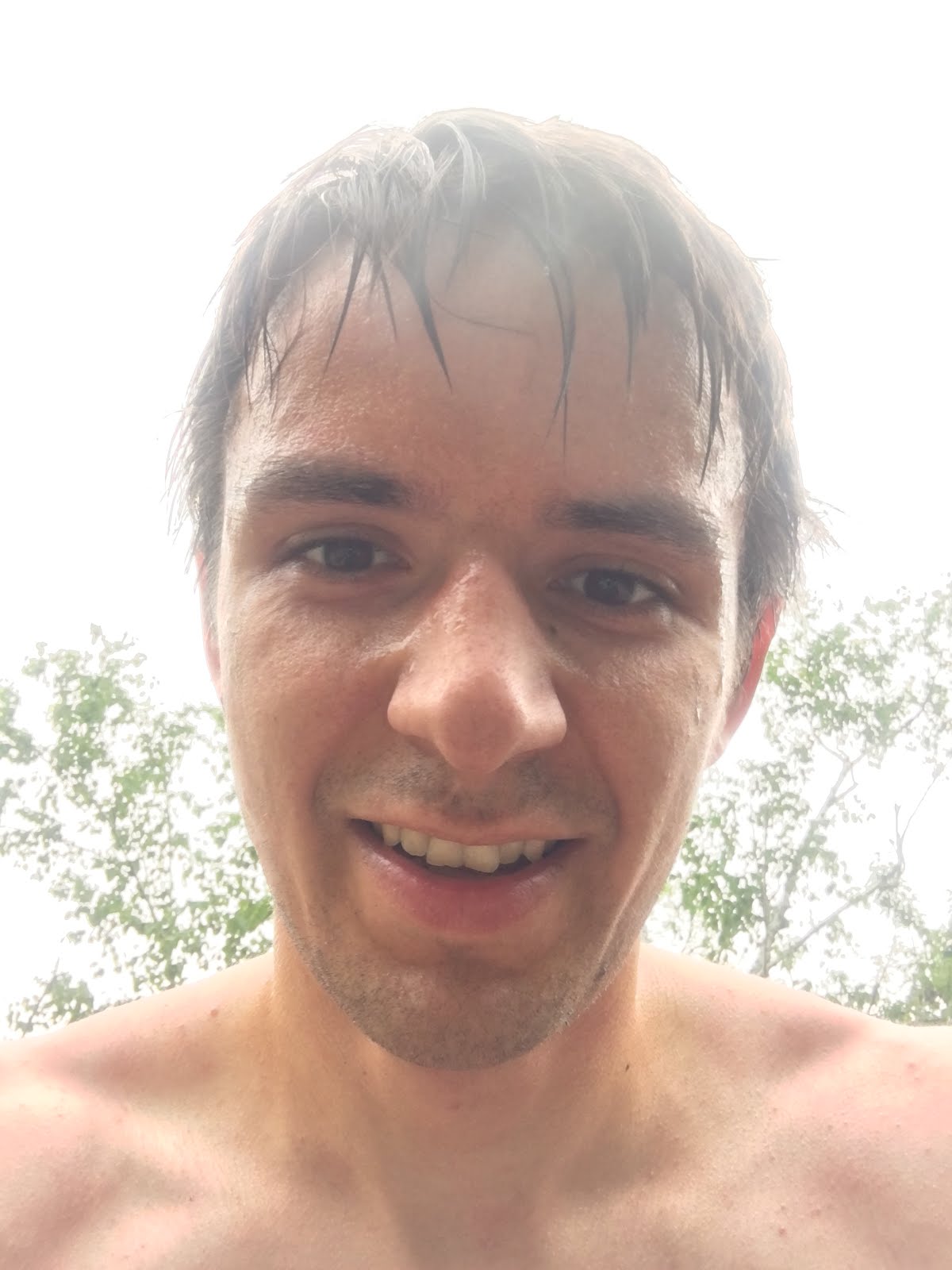
Meanwhile, the rocks slumber. I visited them once and looked like this.

... it was not raining

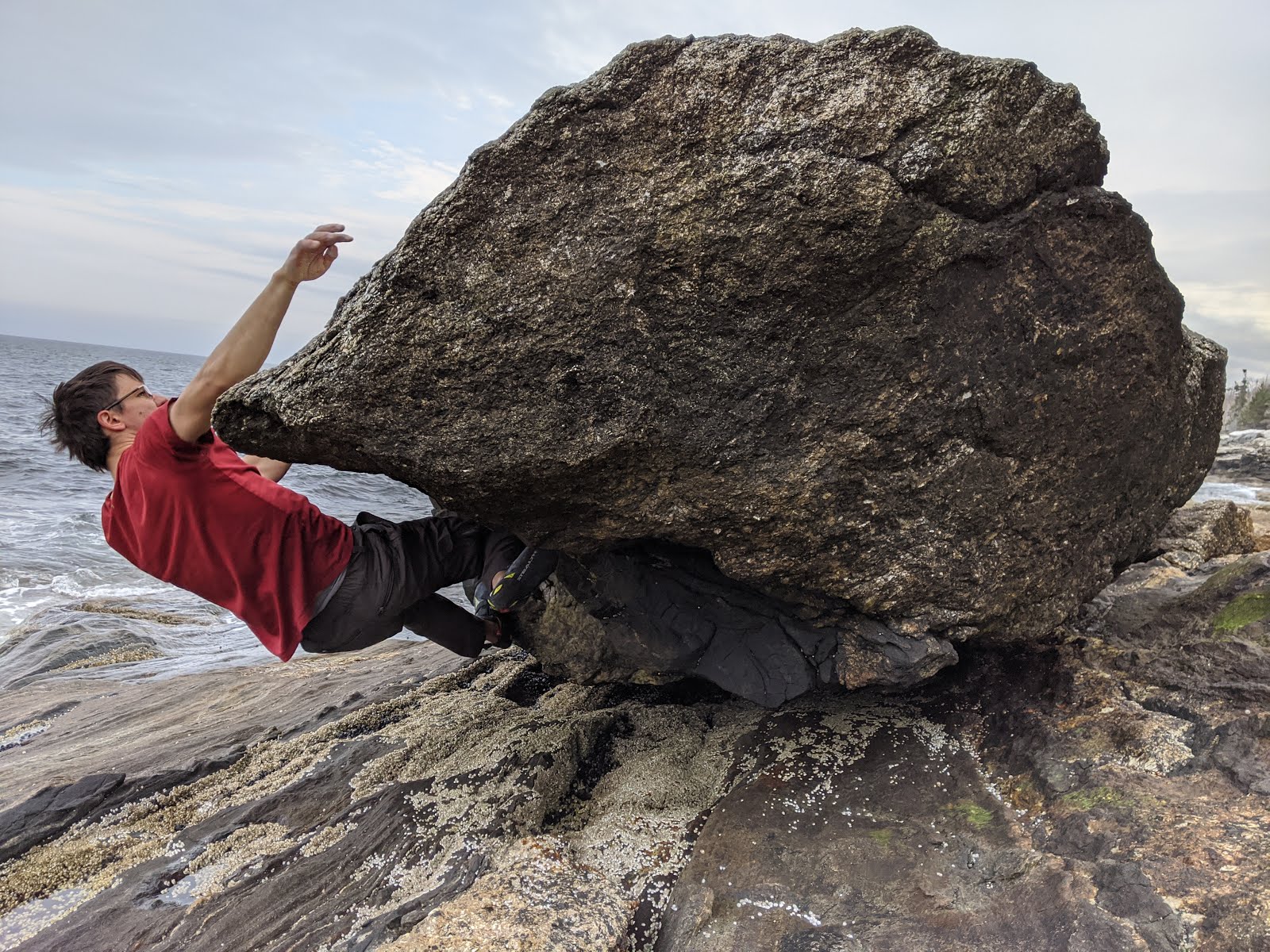
There is one area outwith the trees. Here, the humid air can breathe, likewise the boulderer. I took photos on a 10 second timer with my smart phone, thus:

... looks pretty good, eh?

The heat relented for one day and the bouldering was bliss. It's hot again.

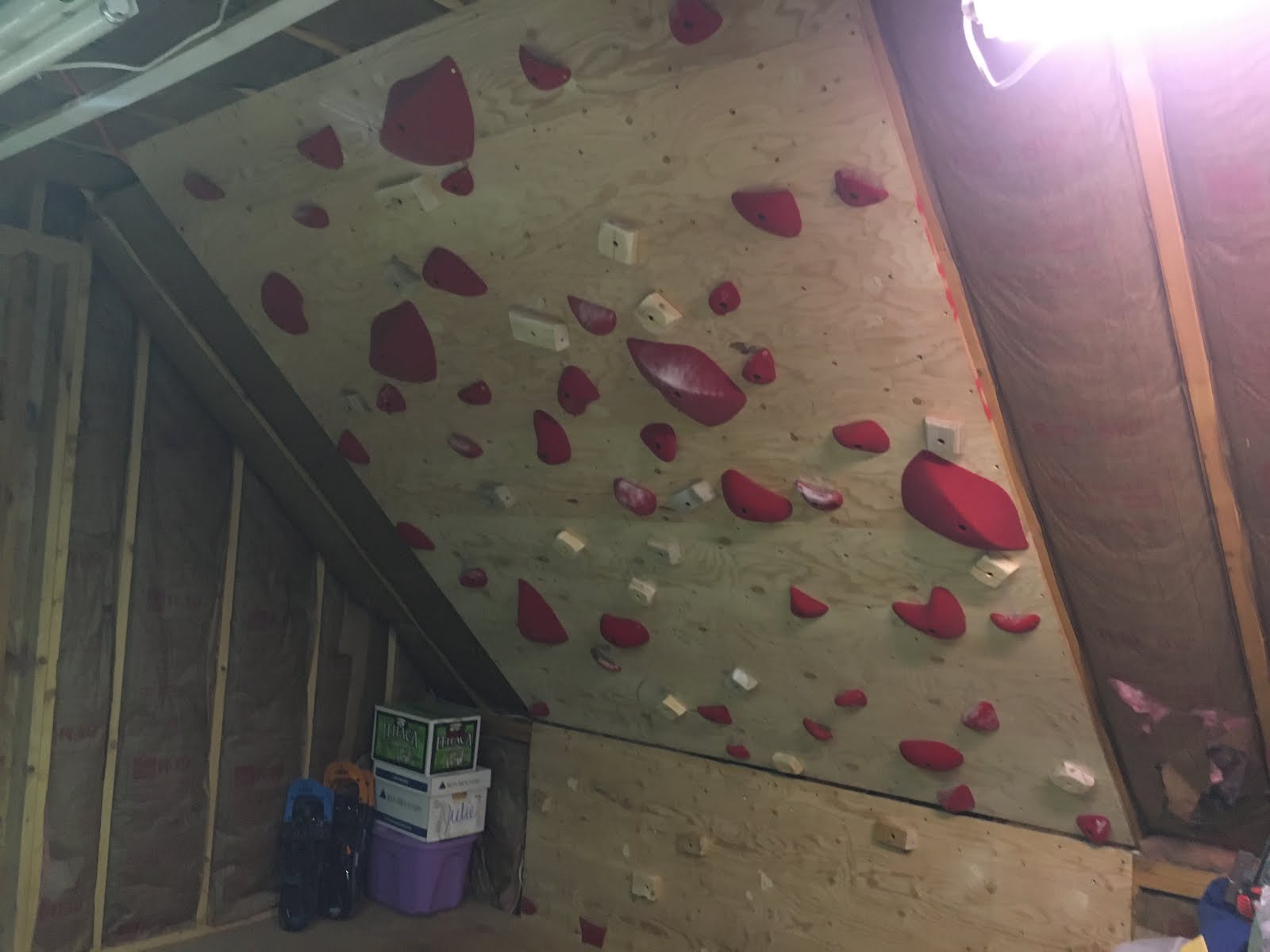
... the 45 board went up

Inside my buddy's barn, we spent our Trump Bucks to build a climbing wall. Richard Thompson said, Red holds and pine plywood, my favourite colour scheme. It's madly humid too, though there is a beautiful, necessary lake to swim for immediate relief.

Perhaps the night will suit me?

Thursday, 4 June 2020

The Traverse


I wrote on October 18th 2019:

"Currently working the traverse... can't do the moves yet, and the last move seems to be the crux!"

June 2nd, the work was done. Let me describe it to you.

Wake up and step on the scales: 152.6lbs, a new low. I've been trying to gain some weight, for more strength endurance. For months I've only been able to have one or two attempts at the traverse per session, then needing a days rest per attempt afterward. Such is my state of fitness. I'd been aiming for a good recovery but... lockdown zen seemed to strike and I don't think I ate very much the previous day. I was light and recovered - I owed myself an attempt. Motivation fragile.

I hopped on my bike and wheeled down to Dodge Point, and walked the mile to the crag. Warm ups. I've learned how to warm up bouldering. One: start slow, Two: top out, Three: enjoy it.

After, I propped my camera phone on my favorite sapling and heading over to the sit start. The first half is power endurance and can be climbed in 40 seconds... V6; very crimpy. Then there's a rest consisting of a big flat hold. In the winter this hold draws warmth out of your fingers. This time it was not too cool, being 70 degrees. It's more of a shake out than a rest.  I caught my breath. The next sequence is great - spin upside down and flick between good left hand holds while pretending to hold a right hand mollusc. Stretched out, cut the heel near front lever, then dead point to a small crimp. I hit the cross over to the good crimp from which it's limit reach to a wobbly flake (hopefully no one pulls it off). Top out was easy thank goodness. Eerie though. Should I be here?

I was there, uncertain, but physically the traverse was complete. And sad. I've climbed everything on the wall; I'll not go back with purpose.

I gave it V10 which I think is a risk... 8b route? I guess so, never climbed one. Maybe someone will repeat it? I've not climbed an establish problem for months. That's on my to do list. I guess "who cares" but, I just don't want to look like an idiot if someone gives it V8.... there are no Brittish 7a moves on it. Maybe a couple 6c ones. Grading is so hard! Someone should make a calculator... wait a sec...

I just googled climbing grade calculator and got this: https://www.bergfreunde.eu/climbing-grade-calculator/, which suggests V10 is french 8c or 14b, which is nonsense!

Look at these examples:

9a+  V15 Wheel of Life long boulder
9a    V14  The Fly short route
8c+  V13 Hubble short route
8c    V12    ?
8b+  V11   Wife of Fyfe traverse
8b     V10  Happiness in Slavery short route, noted as V9
8a+   V9    So Be It short route
8a     V8    Consolidated - long boulder problem, comments say 7c+

Well, disagree if you like. Just watch the vid.


Oh, the name. Rage, Rage. A Dylan Thomas line? The opening to the Iliad? The mental state needed to climb it? The psyche of America today?

Tuesday, 26 May 2020

My Corona

Death, Death, Death! More Death!

I hope your immunity is up.

Governments are happily publishing loads of data on the pandemic, but not really telling you what to do with it, other than use common sense. For a recovering PhD, that can only mean one thing: spreadsheets.


This chart should update daily as more data rolls in.

While the numbers published by governments are not confusing, they are not useful. Number of deaths? Who cares! Ask Stalin.*

The death of one man is a tragedy. The death of millions is a statistic.

What I need to know is: how risky is it to go bouldering? Here's my attempt at common sense, to try and answer that.

There is some Death rate, which I guess is 1%. And there is some average time between catching the disease and dying. I guess 20 days. Why do I guess these numbers? They seem reasonable and fit with some notions like, "lockdown started in late March".

We can now work out the detection rate 20 days ago: for example: if 13 people die today, they've taken 20 days to die. 20 days ago, we measured, for example, 530 cases, however there must have been 1300 cases (1% of 1300 is 13 deaths). Out of the 1300 cases we only measured 530 cases, meaning our detection rate is 530 divided by 1300, or 40%. With more data, we can fit the detection rate and predict what it is today. That means I can guess how many people are currently out there, contagious with the disease, but do not have a positive test for it. For example, say, 71 people are found to test positive today, but detection rate is only 40%. Therefore 177 people have it. I subtract 71 from this, because if someone tests positive, it should be safe to assume they are extremely isolated (known as the Cathy Correction). So that would be 106 new cases. I add up the previous week of undetected new cases to get the total number of contagious people currently in the population. Divide by the total population and multiply by 1000, and ta-da, you have (what I'm calling) the Danger Level.

You can see the Danger Level for different populations in the graph, above. I interpret it as:

Above 5:      Do not leave the house!
Above 1:      Exercise extreme caution, go bouldering alone or not at all, avoid everyone.
Above 0.5:   Bouldering in small groups (one or two others) is ok, once or twice a week.
Any Lower? Larger groups, more regularly!

Obviously, I am no authority on the matter, in case anyone reads this (in that case, Hello! I hope you're well (if I am reading this again, Hello)). I'm aware I conveniently set these levels to fit my climbing patterns, so, blah.

Well, Maine is currently at 0.74, meaning safe for occasional bouldering. I keep a close watch on it as it's trending upward. While the assumptions are very sweeping (and wrong), the method lets me make predictions that are about 20% accurate, one week ahead - compare that to your weather app. They are the best I've come up with so far.

Scotland and UK should be commended for the heroic lockdown they have endured, and are now less dangerous than the generic USA. Maine, off the map, as always, avoided the worse of it, however Tourist season has just begun so we'll see....😬

* Quote not actually attributed to Stalin.


Force of Fate

One year.

Let me tell you something. It has been a year since our immigration status in the USA changed and I have become unemployable. It sucks; unemployment is the worst job. You cannot do only one thing, so between feeling sorry for myself, I started climbing again...

There are few boulderers here, but there is one called Tom who finds boulders walking Homer between the trails in Camden's Hills. He eagerly points me at steep ones and we try to climb them.

The first one I couldn't do was a 50 degree roof with three crimps spaced like campus rungs, too slopey to campus though. We had two sessions on it, and I thought I was close. I went to Europe and climbed some Font 7bs, tried to speak French, and went to a wedding is Croatia. When I came back, I bruised my knee, then I seem to have no memory, then I injured most of my fingers hanging on the finger board, I tried the traverse, and a pandemic happened.

Eventually, yesterday, we got back. Was it going to be easy? No. I was stronger, I knew that I was not close previously. The last move needed to be done almost static in order to have any hope of controlling a great swing when feet cut off. The landing disappears, once I flew past the mats and slid down the hillside. Once, I stuck the second degree move to the lip and scraggled my feet over. This is hardest problem in Camden (as far as I know), so I give it V9 and name it "Force of Fate" after a line in Homer's Iliad, vaguely to do with accepting your circumstances:

But even for me, I tell you,
death and the strong force of fate are waiting.
There will come a dawn or sunset or high noon
when a man will take my life in battle too—
flinging a spear perhaps
or whipping a deadly arrow off his bow.

Mid Coast Classics

The Traverse... 30 moves of power endurance. I've fallen at the last move, and tried it 50 times at least. Seven months of failure.

Time for something other.

Classics. Mid Coast Classics.

Mid Coast Maine, according to wikipedia, is the optionally hyphenated stretch of sea-meets-land from Brunswick to Belfast, 70 miles on the West side of Penobscot Bay.


Episode one... After another failed traverse attempt, I sit breathless. On a whim, I prop my phone on rock and hit record. This problem is V7; it has the smallest crimp on wall. I first did it in October last year after a load of attempts, so it was satisfying to get a retro-flash. Then another with the camera wedged in a sapling. The later is what you watch.


Episode two... Here, Cath climbs. We're at Tracy Shore, where granite domes from pine needle carpet. I think this is V1, and possibly the best problem here. It could be called Earn Your Ice Cream. It is! I have a brother who plays guitar so well, people have written Haikus about him. So that's where the music comes from, I hope I don't get copyright claimed.

Thursday, 21 May 2020

The Lav Trav

Decline of the Blog, views against time.

We're gonna turn this around! Get ready. It seems like content creators are doing vlogs more so than blogs - why? - recording equipment is readily available, and youtube has fantastic reach compared to other platforms. Well, rather than going with the times, I'll stick with the blog and see.

That said I do have a Youtube channel, like the icing on a fruit cake. Remember though, the cake itself is where it's at even if you don't like sultanas.


The Lav Trav is an obvious challenge at a nearby stretch of coast called Laverna. It's a line of flakey jugs at head height with small footholds. At low tide, the landing is really bad - probably an ankle - high tide would be an adventure! The jugs run out for the last two moves, so there's a small crux at the end... no more than 5.11 in USD, or about 7a french. It has been on my radar for around 4 years, so it's great to actually do it. Doing things is very important. The rock is lovely in the late afternoon.

More, Laverna has a load of low-balls to climb on.

Low ball, obligatory squint horizon
Low ball, top out training
If you count all the low balls, there's probably 25 problems here. Nothing hard, but.

Friday, 8 May 2020

Alone


No one asked for bouldering poem, a bit like the pandemic. But here we are.

Thursday, 7 May 2020

Years, days.

What better time to restart the old blog than the end of the world.

I've reread some of my old posts only occasionally. It's a lot of spelling mistakes, enthusiasm, pessimism, sometimes something to make you smile.

Smiling is underrated.

Where am I, where are you, what us changed between us, reader (which I realize probably me)? That's right, I'm living in America. Maine. Off the map. Dave Graham country, but he left a long time ago. We went to a lecture of his in Glasgow, I remember him saying, Maine it's just flat, it's just flat. Which is true.


Even the mountainous areas are pretty flat. It's quite similar to Coigach in that way. Except the forests are not cartographic, viz., they are real.


Endless trees. Why? Look at those trees. They're all pretty young. In the recent past these trees were clear cut. Recent is maybe 300 years... The trees were cut down for the masts of English ships, similar to Scotland. Then, people came and farmed the land - sheep - and you can still see the ruined dry stone walls of this livelihood, again, similar. Then the people left. This was after the American Civil War, so the story goes. The farmers who fought in the war realised the battlefields in Virginia were more fertile than Maine's shallow soil. So, Maine had a "Highland Clearances" of its own, but there's no Hallaig, or Empty Glen eulogising the lost people. This is because these farmers had only been here for a couple generations, and because they left by choice...


People rue the "Maine brain drain" which continues today, but they don't seem to write poetry about it.

Seemingly, the Maine farmers took the sheep with them and the trees came back. The forests are harvested, but there are no spruce plantations. I guess they just chop down whatever has grown. Land is cheap, particularly in Northern Maine: a few hundred dollars an acre if you can buy a million acres... and build a road to get there.

Along the coast of Maine the land is more expensive. This means people can only buy about one acre each, and on that acre they build a big house out of the cheap lumber.


The houses are in the wood. The entire coast of Maine is essentially a giant suburb, in which small town centres dot every 15 miles or so. This is great for the wealthy who own one of these parcels, but is terrible for the boulder hunter - my range is limited to public lands sandwiched between these low residential dough-fests.

Here's a few pic's of what I've found:


Tracy Shore, where to get started.


This is called "Tipping Rock," as yet unclimbed.


Looks better than it is! Pemaquid Point.


The Spot in Camden is really good. Other people boulder here, it's that good!


The local is Dodge Point. I've been trying the right to left traverse for 7 months! Epic.

All pics from Cath.

Stay tuned for more posts, you never know.

Monday, 21 July 2014

Some shit sticks no matter how hard you scrape

I had tried to cycle to Inverness a few years ago, but things didn't work out. I decided to give away that bike for free. We never saw eye to eye afterwards. Anyway, here follows a guide to walking the distance in a reasonable number of days. It's somewhat a guide and somewhat diary entry and I hope it could be interesting from both respects.

Kit list.
I found the follow items to be essential for my walk in June:

Tent - 1 man, less than 2kg, enough room for me and rest of the kit
Sleeping bag - I have a down bag rated to -5degrees
Thermarest - mine is green and looks slightly mouldy, but it works well and doesn't smell.
Cotton sleeping bag liner - essential on warm nights for me as sweat makes my eczema terrible.

Boots - I had a choice between old boots that leaked or new boots which I hadn't worn it. I chose the new ones.
Socks - I wore two pairs: a thin under sock, and an thick hiking sock. In total I had two pairs of under socks and one pair of hiking socks.
Trousers - I had a pair which had zips around the knees so could be converted to shorts.
Underwear - I bought some new pairs. I won't write the number of pairs I had in case my mum reads this.
Merino wool long sleeved top - loved this item and wore it constantly while walking
Fleece
Gloves
Waterproof jacket and trousers - vital.
Midge net

Compeed - I went through an entire pack. A mixture of sizes is probable best. I had a pack of large which I had to customise.
Small medical kit - not needed, but I thought up the following quip, "better a load on your back than a load on your mind."
Penknife
List of distances between towns/checkpoints - I'm quite familiar with the route so didn't take a map - it is well way marked.
£50 + bank card.

Food - buy it on route, but start out with some energy bars and lunch. I started out with far too much.
Waterbottle + dissolving energy tablet things

Day one - Milngavie to Rowardennan

I took the train to Milngavie. At some points along the walk, I wished I had walked there from my flat, but most of the time I was quite happy to have done so. I reasoned I would be 5 miles further back than where I was had I started from my flat, and when every step is precious and valued, to be back 5 miles didn't seem worth it. Anyway, I was at the start of the West Highland Way at about 7.30am. I was able to overtake a party of 3 here has they stopped to take photos. In Milngavie, and the few miles outside it, there were people walking to work, joggers, and mountain bikers. After 5 miles, Carbeth and huts. I could see Craigmore, probably the most pleasant bouldering in Glasgow area (for at least 2 weeks each year). About a month previously, I fell of a problem there and sprained my ankle. It was still sore. I was having to stretch out every mile or so. I had entered the Kilpatrick's hillrace the weekend before and hadn't recovered. I finished a not so respectable 117 out of 120.

From Carbeth to Drymen there are 7 miles. You walk past Dumgoyne, where there is a distillery. I didn't stop there, but I did stop to speak to a couple of Americans who I had overtook. After overtaking them, I needed a pee really bad, but didn't want to stop incase they caught up and I had to speak to them again. This inhibition, I lost, by the end of the day. I have walked up Dumgoyne a few times, most recently with my brother and Sarah. At Croftamie I met a horse and rider. Arriving at Drymen, I stopped myself. I was at the point were the N7 cycle route crosses the West Highland Way and I lingered.

Drymen to Balmaha is where the walk becomes more highland - prior to this the walk is fairly lowland, worked heavily with agriculture, forestry, houses, roads and so on. After Drymen, the land starts to relax and do its own thing. Views open up a little and conic hill soon arrives. I had lunch near the summit - I didn't go right to the top, done it. I was overtaken by some Germans but I saw them heading off South at Balmaha so they don't count. It may sound like I was being quite competitive, probably because I was. I didn't relax out of this overtaking mentality throughout. I swapped stories with folk I passed and didn't let on that I was racing them, but I couldn't help wanting to track down people a head of me.

Balmaha has a good shop and a pub. I'd recommend getting a good meal here. To Rowardennan, I overtook and was overtaken on multiple occasions by a Chinese woman. We arrived at Rowardennan at about the same time and chatted for a bit. I refilled my water at the tap and headed on North, while she checked into a hostel. The national park police were making it clear that they are intent on enforcing the bylaw of "no camping near the road" so I had to keep walking until I was out of the restricted area. The WHW is currently being upgraded here, so I walked past all the construction and camped somewhere past Rowchoish near a burn. I wasn't sure whether drinking water from the loch or the burn was better, and guessed the burn. Google tells me it was a good guess. I found the midges were not a problem at the loch side but were bad in the trees. I soaked my feet in the loch. I found one blister on the inside on my big toe.

Day Two

From my camp to Inversaid I past the track where my pal Jonathon and I ended up after an attempt to run around Ben Lomond. We had aimed to stick to the 450m contour line but the weather meant we had to abandon it on the back side, turning north to the Cailness burn and back along the WHW to Rowardennan. At Inversaid I was reminded a time when Danny, Simon and I had a day's climbing at crystal crag years ago. Retracing those steps, I passed the boulders were folk walking the WHW had gawped at us doing sit starts. No one was bouldering when I walked by. The north half of loch Lomond is tricky in terms of terrain, and unpleasant in terms of atmosphere. The path is tangled up in boulders and the vegetation is close. I was glad to make it to the campsite at Inverarnan. There is an ok shop here, and I bought some bananas. I had 5 blisters by this point which I had compeeded. For some reason I didn't get any more, although the ones I had caused me pain from here on.

To Tyndrum, the main event was an altercation group of possibly Eastern European walkers I was tracking them down having overtaken them, then been overtaken by them. Up ahead a style, and they had left behind one of their dogs. The yelping dog was small and couldn't make it over. I walked up and was about to help it over when the group's second dog came running back, and was barking too. Confused, then more so, the possible Eastern Europeans appeared from behind a wall saying "don't!" - it turned out they were trying to train the dog to jump over styles. I overtook them promptly. As an aside, I don't think taking a dog is a good idea as you will have to carry a lot of extra kit for it. I saw some with a dog who had equipped the dog with some kind of backpack - fair enough, but it does look stupid.

It rained as I headed to Tyndrum. I met an American family who were chatty, the matriarch in particular. It rained and rained. Eventually I was in the Green Welly Stop for some hot food and a cold beer. A low point was leaving there to make some more progress at about 5.30pm as it was still raining rain. About a year ago I had ran from Tyndrum to Bridge of Orchy with Richard as he competed in the WHW race. I half remembered there being a river and flat ground at some point so I headed for that and hoped it arrived soon. When it did, the midges were terrible.

Day 3

The rain eased off by morning and I was walking by 8am or so. I arrived at Bridge of Orchy for a chance encounter with a friend from the climbing wall who works taking youth groups up mountains (it turned out). He asked what I was doing there, I told him I had walked, and he told me that I could've got the bus. To my dark delight, on the hill just above Bridge of Orchy, there was a rock with the inscription "J. Bloggs, gone to soon." Over the few days, if I needed cheering up, I'd imaging asking the inscriber where "soon" was. I suspected the answer was that it was near Troon.

The Rannoch moor required a bit of soul searching, my legs and feet ached. I figured the cobbled path might help work different parts of my feet and so ease the pain, but I don't think it did. I stopped and soaked my feet in a burn and got overtaken. That said, it is probably the finest section of the walk. I was in the King's House for mid afternoon and order a haggis panini and a pint. My opinion is that beer is a very good option - full of carbs and easy to get down. I waddled out as my legs had stiffened up, but I was soon below the Buachaille, looking up at many memories of curved ridge, Rannoch wall, Slime wall and Tunnel wall. The Devil's staircase was climbed slowly, and I had a great view North at the top. I forgot to have a look South, and descended steadily to Kinlochleven. It was a Sunday, and all the shops were shut. I sat on the curb briefly then set off up the other side of the glen and made camp high above the town.

Day Four

I was meeting Jonathon in Fort William at lunch time so got up early. I had something resembling a wash in a river. I have always been a bit of a wimp when it comes to cold water. Along the path I past two parties who had made camp further on. One of which consisted of a man singing loudly until he must have heard my footsteps. At this, he stuck his head out his tent and said a sheepish, "mornin'". I didn't see either party for again though, despite my pace being slower now. It was a fantastic morning with a bright sun and cool breeze. I stopped and listened to the birds and meditated, "this is going on all the time; these birds are chirping every morning." Sometimes simple thoughts are sensible.

Part two,

Fort William - Inverness

Later.

Wednesday, 21 May 2014

A short note about votes

Some people say that they can't be bothered voting because it won't make any difference to the outcome. Of course, I agree that it won't make any difference to the outcome. You might say, a ha, but if everyone thought that then no one would vote. Well, I don't think that is true. Think what follows - people only vote because they think it will make a difference to the outcome. And then, people will only vote for people who are likely to get in, in a way, to prove themselves right. I suggest that the myth that "your vote makes a difference" is therefore propagated by the main political parties in order to maintain the status quo. I say to you that the chance that your individual vote will make a difference is so unlikely that saying such things is ridiculous.

Instead of thinking of voting as a method of defining what the country is, think of it as a  way of defining who you are. If you are old, you probably have defined yourself already. But, if you are young, there is a real opportunity to say something about yourself. I think that is more important than who runs the country anyway.

Monday, 28 April 2014

Flooring

Some landings at Dumby have been patio-d very nicely by some folks. Areas which have been worked are the landing under Mugsy, and the slope under Slap Happy. Another area is under 2HB, although I don't know why this area was chosen as the landing was not greatly improved and erosion was not as much a problem as in other places (I have no problem with that patio being there, however). Since I've not been too regular recently I don't know when these were put in.

The worse area of erosion is under Slap happy. This is due to a combination of the popularity of the problems, and their lines being difficult to cover with one pad. Since the area is rather dank, regeneration of turf is not likely without stopping of climbing on those problems. Instead it would be perhaps best to protect the turf that is there by fully patio-ing the whole area (up to the turf), built up from the tree to the sucker boulder. This amounts to a lot of work.

I visited some boulders in Boulder, Co, last year, and saw that they could do with some patio-ing. However, the local I was with told me that was unethical, and it should be left "natural", despite years of erosion had now exposed large, pointy boulders. I got the impression he agreed with me, but the local consensus was against maintenance.

At Dumbarton, I suspect no one would be against patio-ing the landings to protect further erosion. But what about else where in Scotland? I've patio-d landings in remote-ish places, where erosion is not a problem, but just to make the things safer. I've done this by rearranging the nearby stones to fill in holes or trundled large boulders. I think this was reasonable as my attempts tried to make things look natural, with (hopefully) no large areas of exposed earth.

Removal of plants and trees is a step further. At Dumbarton, there was a large tree growing out from under the Eagle boulder which has been "pruned" (read: chainsawed) on a few occasions, and a small tree below 2HB has been removed. Anything goes at Dumbarton. Elsewhere though, removal of trees has happened and, although I've not done it personally, I've enjoyed climbs which have been opened up. I'm not too sure what the legality of pruning wild plants and trees is - I think picking wild flowers is against the law, so I imaging cutting down trees is probably frowned upon. If there is a law, it's 99% irrelevant as no one is policing the remote anarchy of scottish bouldering. It comes down to a judgement of the person involved - is the route worth the tree? To calculate this, I propose the following formula:

Worth of route = Number of stars + number of people likely to try to climb it per year
Worth of tree = Floor[(Estimated age of tree^2)/10] + 1 (if native) + 1 (if visually appealing) - inf (if rhododendron)


Tuesday, 18 February 2014

List

I gave up Climbing for a PhD. This was probably not a mistake because I don't remember most of the past four years on account of not writing important things down, and hence, no time seems to have past. The clock paused for four years, and, with this, is unpaused. Rewind is not an option, alas! Nothing is as motivating as a list, so here's one I've working on in the back of my mind for a few years. It's a set of 5 problems - one from each boulder. Assuming all the holds are still there.

Dumby 7B+ Challenge - climb them all in a day/lifetime/whatever.

1) Consolidated. Long like a route, low like a sit start.

2) BNI direct. including direct top out.

3) The Shield. Without "wee undercut".

4) Mugsy traverse. Only a 7B because...

5) Silverback. ... is 7C


Sunday, 25 March 2012

Saturday, 24 March 2012

Wednesday, 16 November 2011

Font 1

For a range of pitiful reasons (laziness), I'd never been to Fontainbleau. So when my office buddy/climbing friend Arran asked if I wanted to go with him John and another Inverness Mike, I needed a bit of persuading. Particularly with a danger of having to share a double bed with Arran, I eventually agreed.


People say, "Font is the best". As I really like other places, I didn't want these to suddenly seem crap compared to Font. Better to stay at home? It took me a while (years), but I realise that whatever Font is is irrelevant, what matters is one's relationship with place. With this in mind, I could fearlessly travel to Le Bleau knowing my cherished memories of Duntelchaig were safe. Also there are no good photos of Font as cameras can't capture the light and dark at all well compared to the eye.

The team:


I was the youngest, with 3 of our year of births following the 11 times table 66, 77, 88. John having fantastic knowledge of the forest which saved so much faff and probably doubled the amount of climbing we did. Mike had an excellent vocabulary which turned bumps in to crenulations and others things which I've sadly forgotten. Arran brought an SLR so I'll ask him for some pics which are better than mine above. I brought "business" jokes; here's examples:

-I'm in business
-Oh really, what business you in?
-The magic business
-Nice, hows it going?
-Tricky

-I'm in business
-Oh really, what business you in?
-The see saw business
-Nice, hows it going?
-has it's ups and downs

-I'm in business
-Oh really, what business you in?
-We sell sea shells by the sea shore
-Nice, hows it going?
-Hard to say

The highlight had to be finding a board game in the gite, Peak Experience, tag line: "you don't need to be an expert climber to play Peak Experience!". Sure, you could in principle play; answer multiple choice questions to make it to the summit of K2. I arrived at base camp a good while behind the others (slowed by my sampling too much of the local food and trying to burn animal dung) only for bad weather to push me back 2 places. Mike battled for a number of turns to get off the summit, at one point forced down climbing the top pitch of his chosen route. John eventually glissaded down the descent to victory. The next night we got a 5l barrel of wine.

Real climbing wise, I adopted the adage, "a 7a a day keeps the doctor away". It worked; none of us needed medical attention. Most of the time was spent amongst the mushrooms, lost in the woods, cleaning sand off from everywhere. I got scared on some highballs, learnt a bit more about slabs, the difference between dry and clean shoes and how not to mantel. Sabbot, Elephant/Cuvier, Apermont - just three days climbing; my appetite whetted for Font 2.

Sunday, 23 October 2011

Looking back/forward

So, since last time. Well, the climbing flat, my home for the past four years, has ended. That is the occupants have moved out rather than the flat has burned down... although that nearly happened at the end of year one there. There were certainly plenty of good times there.
For those were around, I'm thinking of Murdoch being a Christmas tree, Murdoch and Ben's climbing debates, building a woodie, learning to juggle, the day King Lines arrived, putting up the finger board, drinking a bottle of Jameson with Danny, Boost buying a red light bulb for the bathroom, Boost putting his lecture notes in the bin, the man downstairs complaining about my dancing shaking a picture off his wall, Stew throwing a Mars bar at the guy downstair's window, going round to the girl next door's flat party and not fitting in.... ooo we had a blast! The three of us (Nic, Murdoch and I) have moved on to new things. For me, I've moved in with my girlfriend which I think was very brave. I've only slept on the couch once and that was because Cath was away and I was drunk. Anyway, my new flat is dead close to Hynland Railway station which is great for getting out to Dumby (I'm still waiting for some good weather to get there though), or to the Kilpatricks, where I've done some running.


On the climbing front, well my skateboarding injury is pretty much mended... I have a good bit of keenness to get out climbing after a year of basically nothing. The first year of PhD-ing has been good fun, but on reflection I could've done more climbing. In recognition of this, a couple of weeks ago I bunked off work at short notice and headed to the peak with Cath. This was the first trip where there was no rain the entire time. What a lot of blue sky! As such, the tempo of the days was slow and peaceful, I meandered up a few easy solos and took Cath up some of the Diff's.

Next up is trying to get as much into my days as possible. Getting a few things done this year of my PhD will set things up for an good final year, hard work now will certainly pay off. Also, I'd like to work on my music skills, and chess skills, and get in shape for climbing hard projects. Optimism... It might happen!